
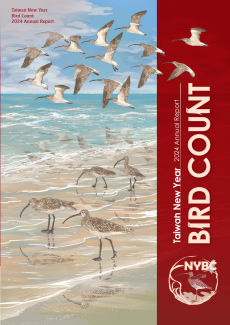
The Taiwan New Year Bird Count (NYBC) is a citizen science project that monitors the status and trends of wintering birds in Taiwan and its outlying islands. The 11th report presents the results of the 2024 count, which was conducted between December 16, 2023 and January 7, 2024. Over the 23-day survey, 878 participants recorded 394,483 individuals from 343 species in 172 sample circles across Taiwan proper, the Penghu and Matsu Archipelagos, and the Kinmen Islands. Thanks to the enthusiastic support of birders, partner organizations, donors, and sponsors, the eleventh consecutive year of the Taiwan NYBC has been successfully completed. The organizers gratefully acknowledge the support of the Forestry and Nature Conservation Agency, national park headquarters, E.SUN Bank, and other sponsors whose generosity has made this project possible.
This year’s report also marks an important new milestone for the project. For the first time, the annual results include analyses of overwintering landbird populations in addition to waterbirds. Most monitoring and research in the East Asian–Australasian Flyway (EAAF) have traditionally focused on migratory shorebirds, while coordinated efforts to track landbird populations remain relatively recent and limited in scope. In this year’s report, the Taiwan NYBC contributes to this growing conversation with its citizen science data. The findings reveal concerning declines in several farmland and grassland species, such as the Red-throated Pipit (Anthus cervinus), Siberian Rubythroat (Calliope calliope), and Brown Shrike (Lanius cristatus). Regional differences were also observed: farmland birds declined most sharply in southwestern Taiwan, while forest birds showed notable declines in western Taiwan.
These trends serve as a warning that the loss of farmland and natural grasslands in recent years may be affecting not only breeding bird species, but also migratory landbirds that depend on these habitats to rest and refuel during winter. This underscores the need to give greater weight to ecological balance in land-use planning and provides more precise regional references for future conservation work.
Meanwhile, waterbirds remain at the heart of the NYBC. With the inclusion of this year’s data, we found that this year’s mascot, the Eurasian Curlew (Numenius arquata), has declined by 74% compared to 2014. The Yilan Plain continues to be a hotspot of waterbird decline, suggesting that local conservation efforts alone are insufficient to counteract broader land-use changes across the flyway. By contrast, more positive trends were recorded along the Chianan Coast, demonstrating how effective habitat management and conservation measures can provide critical refuges for migratory species.
These findings, both sobering and hopeful, underscore the value of long-term citizen science monitoring. Only through consistent and sustained efforts can we track population changes and evaluate the effectiveness of conservation strategies. To further strengthen this work, the NYBC organizing team presented these results at the International Congress for Conservation Biology, sharing Taiwan’s citizen science achievements with researchers across the East Asian–Australasian Flyway and contributing to ongoing international cooperation in bird conservation.
The Taiwan NYBC is organized by the Taiwan Wild Bird Federation (TWBF), the Wild Bird Society of Taipei (WBST), the Kaohsiung Wild Bird Society (KWBS), and the Taiwan Biodiversity Research Institute (TBRI). The organizers would also like to give special thanks to Allen Lyu (呂翊維, TWBF), Scott Pursner (潘森識, TWBF), Chiang Kung-kuo (蔣功國, WBST), Lin Kun-hai (林昆海, KWBS), Lin Ruey-shing (林瑞興, TBRI), Chi Po-wei (紀博瑋, TBRI), Tsai Chih-yi (蔡芷怡, TBRI), and Lin Da-li (林大利, TBRI) for their tireless effort in making the first decade of the Taiwan NYBC a reality.
The organizers would also like to thank Tamako Diary and Daylily for the cover and interior illustrations, Ms. Jung Chao for assistance with data processing, and Tien-Ching Culture Enterprise for the design and layout of this annual report.